Had a talk with James and Andy about our exhibition and project in general to make sure that we're okay.
We showed them the working engine, we also took videos of the engine working in case it stops working. I don't think they were very impressed to be honest, it felt like they thought it was too simplistic and straightforward.
Other than that, there were some really good points that we haven't thought about. They pointed out that our methodology in doing our project is heavily reliant on technology. This contradicts with the point that our project is to show how heavily we rely on the power grid and technology to do our daily activities. There's a contradiction because we've used the internet extensively to learn how to make those engines and do our research. We've also used laser cutting to cut our engine parts, which is another piece of technology.
Also, we've focused so much on how to get the parts working that we've forgotten the meaning behind our project and therefore lost our compass in taking our project to the next level. Having that conceptual underpinning to give a background and greater context to our work would be best for us, so afterwards the group had a talk about what we want to say with our work.
We're still trying to show how heavily we rely on technology, and how we use technology to preserve our comfort in modern living. People want to do things the easy way because easy is comfortable. This is why people tend to rely on technology; because it's easier.
As for the style, we've decided that it's going to be like being in the workspace of a tinkerer or person who makes things. Basically, our character is going to be a person in the future where technology requiring electricity can't be accessed and he/she is trying to take back the comfort that they had before in life but without relying on electricity so much. Looking for an alternate source of power first by trying to make communications easier.
Wednesday, May 30, 2012

Tuesday, May 29, 2012
Networks: Switches refined
Tim and Ben got more switches made with some improvements to the design and we tested them out. The switches still look rather crude, but the point is that it works. We found that we needed to make adjustments to the counterweights when we tested them though. The counterweights were too heavy for the ping pong balls.
Also, to make the CD flywheels look a little nicer I peeled off the silvery bits so they're now see-through. It looks much cleaner this way.
Also, to make the CD flywheels look a little nicer I peeled off the silvery bits so they're now see-through. It looks much cleaner this way.
Friday, May 25, 2012
Networks: Working
The engines are finally running. It was really surprising because none of us were expecting one to work. We got one working, but the second needs more adjustments.
While Ben tinkered with the engine he gave it some spins of frustration, after it failing to work after a myriad of tries and adjustments. After much profanity, the engine budged and finally got running.
It was a great day.


As a result motivation and morale has risen. I think this would give us more energy in getting through with out project.
While Ben tinkered with the engine he gave it some spins of frustration, after it failing to work after a myriad of tries and adjustments. After much profanity, the engine budged and finally got running.
It was a great day.
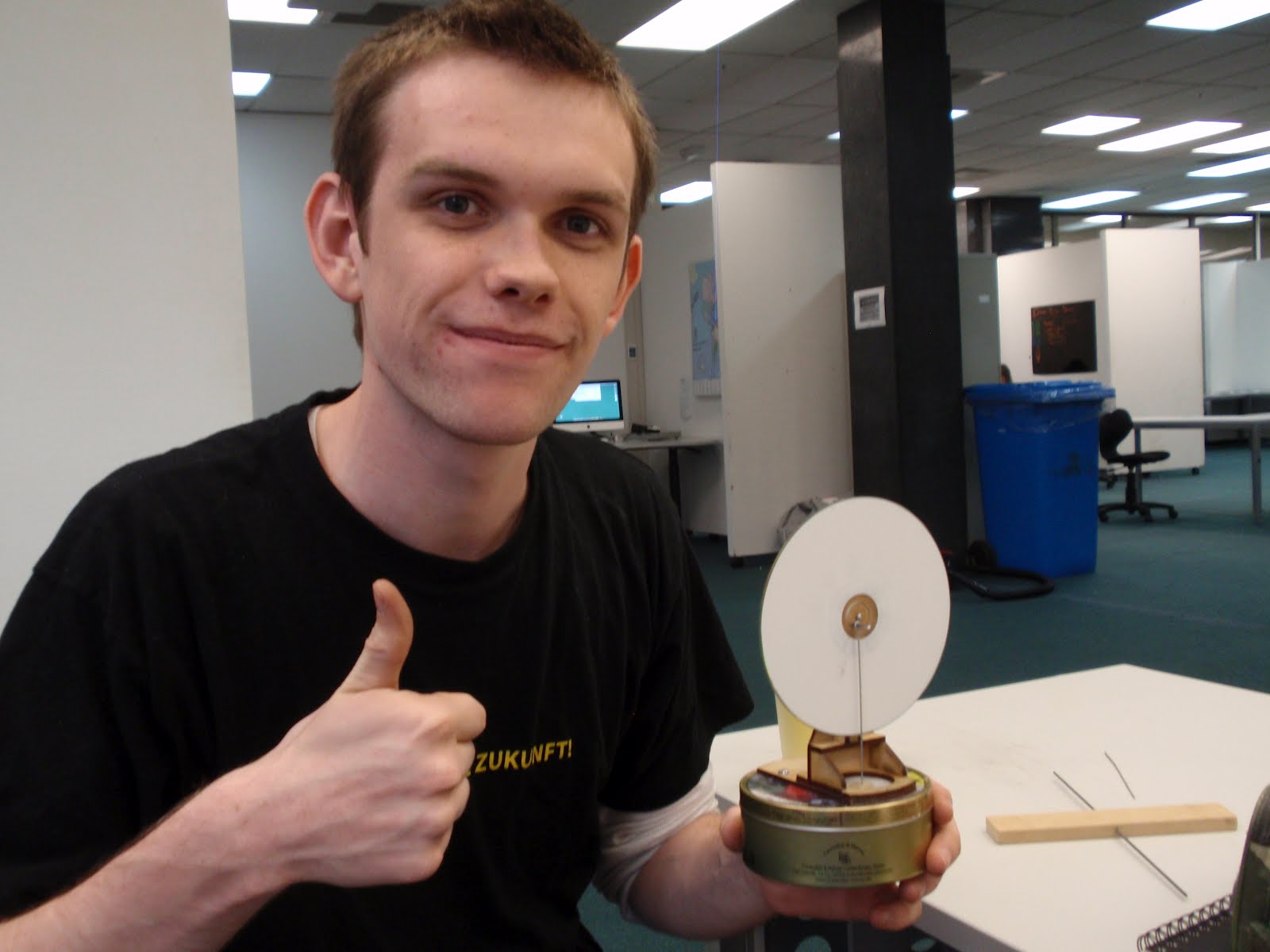

As a result motivation and morale has risen. I think this would give us more energy in getting through with out project.
Thursday, May 24, 2012
Networks: Everything's Wrong
We've nearly got our stirling engines working, but they're not quite there yet. Ben and Edrian made more adjustments in how the parts are aligned. It's getting better, with the heat the displacer feels like it wants to do something when you wind it because it feels lighter than it should. However, it's still not going yet.

As for the rails, they're going terribly. Tim and I tried bending them into the right shape but the wire proved difficult to work with. Also, when we tested it out I realised that the design didn't exactly make sense. We're going to have to make changes to the design. I don't think they'd be big changes, but I do think there must be a better way to work with this wire.
Feeling pretty demotivated and mildly confused as to what to do as well. Need more sleep.

As for the rails, they're going terribly. Tim and I tried bending them into the right shape but the wire proved difficult to work with. Also, when we tested it out I realised that the design didn't exactly make sense. We're going to have to make changes to the design. I don't think they'd be big changes, but I do think there must be a better way to work with this wire.
Feeling pretty demotivated and mildly confused as to what to do as well. Need more sleep.
Wednesday, May 23, 2012
Networks: Simplification
Made all wall of nails and decided to simplify the tracks. We've decided not to add in zig-zags because they're not absolutely necessary. One reason is because we can control the incoming flow of ping pong balls with the frequency at which a ball is brought up to the track at the engines. The second is that time is running out and the making of zig-zags would be more time-consuming.
I haven't blogged about our critique marks yet. Today I'll take this opportunity, since not a lot happened.
We got a not-so-good mark and only now I realise our flaw.
With our presentation, the structure wasn't good enough in coherently communicating the meaning and ideas behind our project. Also, some of use, namely me, didn't talk much. This needs to change. We all need to be more engaging and discard our shyness. Outside of our presentation, I think my group isn't interacting with other people's ideas enough. We should really take in what other groups are trying to communicate so that we can give good critiques, which would be beneficial to both my group and the group in question. I think it would help my group and I to view our project more objectively to effectively solve our problems. These are the things we need to improve on.
There's one group that I've been watching closely. I watch them because I envy them in how well they work together and I view them as the model group. I'm not saying that every group should be just like them, I'm saying that the way they work and fit together is something that other groups can learn from by example. I've talked to one of them and he says that three of them make one programmer while the other two group members take care of the visuals and musical side of their project. I think the reason why they work well together is not only because they click and "speak the same language", but also because their skills compliment each other for the project type they've chosen. They have a nice flow that keeps them going.
In comparison, my group does work quite nicely together. I'm not sure how our current project will turn out, but I can tell you for sure that when I look at our various skill sets we're made for films. We have director material, a fine photographer who knows how to work the camera, an editor and another amazing with effects. Maybe in the future we could work projects to our advantage by leaning more towards film-related options?
Also, by talking to other people and listening to their opinions, I find that my thinking is simplistic and naive in comparison. I'll admit that my mind isn't very rich with life experience because I haven't lived very long in addition to being rather sheltered. I think I need to think and consider more in a wider range of perspectives.
I haven't blogged about our critique marks yet. Today I'll take this opportunity, since not a lot happened.
We got a not-so-good mark and only now I realise our flaw.
With our presentation, the structure wasn't good enough in coherently communicating the meaning and ideas behind our project. Also, some of use, namely me, didn't talk much. This needs to change. We all need to be more engaging and discard our shyness. Outside of our presentation, I think my group isn't interacting with other people's ideas enough. We should really take in what other groups are trying to communicate so that we can give good critiques, which would be beneficial to both my group and the group in question. I think it would help my group and I to view our project more objectively to effectively solve our problems. These are the things we need to improve on.
There's one group that I've been watching closely. I watch them because I envy them in how well they work together and I view them as the model group. I'm not saying that every group should be just like them, I'm saying that the way they work and fit together is something that other groups can learn from by example. I've talked to one of them and he says that three of them make one programmer while the other two group members take care of the visuals and musical side of their project. I think the reason why they work well together is not only because they click and "speak the same language", but also because their skills compliment each other for the project type they've chosen. They have a nice flow that keeps them going.
In comparison, my group does work quite nicely together. I'm not sure how our current project will turn out, but I can tell you for sure that when I look at our various skill sets we're made for films. We have director material, a fine photographer who knows how to work the camera, an editor and another amazing with effects. Maybe in the future we could work projects to our advantage by leaning more towards film-related options?
Also, by talking to other people and listening to their opinions, I find that my thinking is simplistic and naive in comparison. I'll admit that my mind isn't very rich with life experience because I haven't lived very long in addition to being rather sheltered. I think I need to think and consider more in a wider range of perspectives.
Tuesday, May 22, 2012
Networks: Wall of nails and wire

Today, we made one wall of nails first to test out its effectiveness. We don't want to make all of them only to find out that they don't work, so better safe than sorry.
The test came out quite well. The nails slow down the ping pong balls quite a bit so we can make more of these.
In addition to the wall I also made some spacers for the rails. These are to keep the width of the rails the same distance the whole way through. This way we won't need to worry about keeping the fiddly bits in position with the help of the spacers.
Meanwhile, we still haven't got the engines working. It's looking pretty bleak. What I find with most of our projects is that we really rely on some piece of technology to work in order to complete a project. We focus so much on how to get things working that it feels like the meaning behind the work is lost to desperation in trying to get it to work.
Monday, May 21, 2012
Networks: Measurements+Templates
Today we're fully on track and on task again so I'm really glad. Got measurements down for making the ball tracks and the bits for slowing down the ball and a rough template of how things are gonna fit together.
I showed Tim videos of the wall of nails, spiral of nails and zig-zags that we could be building to see what he thinks. We decided not to do the arc that slows down the balls because it would be too big and chunky. It would be more of an obstruction. The zig-zags however, would be the best option as well as the wall of nails. We gotta keep the sizes in mind so that we don't make them too big, or else we would have a hard time twisting the rails this way and that. We want to keep the rails as straight as possible so that it could travel a little quicker between points. Curves would give a longer path.

Marked out with circles where we would need to slow down the ping pong balls. The places where we need to slow them down are all before the ball meets the switches.
I sketched out the options we have for slowing down the balls and made modifications to suit out needs.
Above we've got wall of nails (the rectangle and trapezoid with diamond arrangement of dots). I'm thinking is we made it into a trapezoid shape we could limit the flow coming off the wall of nails, therefore slowing it down further.
Spiral of nails - To make it slower the pole would be bigger. Bigger pole -> longer path -> slower ball.

For zig-zags, in the previous page I've got triangles making a simple zig-zag. To make more interruptions of momentum it would be better to add thin strips of wood at a very slight angle instead. This also lengthens the path the ping pong balls have to travel through.
Above is also a rough sketch how how the switches would be integrated into the path. There's also a side view with switches dropping down the balls on to wall of nails (trapezoid) and wall of nails (the two straight lines). The second side view drawing is a path interrupted by spiral of nails that joins up to the rest of the path. These are options, but I think we could come up with something better than that.
Zig-zags are a definite thing, so tomorrow Tim and I will be going up to the 3D labs to get working on those and maybe on the wall of nails too since it would be easy to do that.

Here I've drawn the size for the wood on our zig-zags and the spacing between nails. So we could lay this over the wood and cut/nail.
Ben and Edrian are doing really well on their progress on the engines.

They drilled some holes today on the sweet tins and assembled the top part of the engine as well.

This bit is the top part.

This is the diaphragm of the stirling engine. So this is the bit where the air pressure moves it up and down. This is where the cranks is connected to.

We talked about how thinking back on it we should have begun with this engine in the first place, since this one has the highest chance of success. We only canned this one in the first place because the materials weren't as common as the previous designs. However, we agreed that if we did do this first we would never have thought to laser cut the parts and would've spend many frustrating sessions trying to get the precision right up in the 3D labs. So it's kind of a good thing that we failed several times before moving on to this design.
I showed Tim videos of the wall of nails, spiral of nails and zig-zags that we could be building to see what he thinks. We decided not to do the arc that slows down the balls because it would be too big and chunky. It would be more of an obstruction. The zig-zags however, would be the best option as well as the wall of nails. We gotta keep the sizes in mind so that we don't make them too big, or else we would have a hard time twisting the rails this way and that. We want to keep the rails as straight as possible so that it could travel a little quicker between points. Curves would give a longer path.

Marked out with circles where we would need to slow down the ping pong balls. The places where we need to slow them down are all before the ball meets the switches.
I sketched out the options we have for slowing down the balls and made modifications to suit out needs.
Above we've got wall of nails (the rectangle and trapezoid with diamond arrangement of dots). I'm thinking is we made it into a trapezoid shape we could limit the flow coming off the wall of nails, therefore slowing it down further.
Spiral of nails - To make it slower the pole would be bigger. Bigger pole -> longer path -> slower ball.

For zig-zags, in the previous page I've got triangles making a simple zig-zag. To make more interruptions of momentum it would be better to add thin strips of wood at a very slight angle instead. This also lengthens the path the ping pong balls have to travel through.
Above is also a rough sketch how how the switches would be integrated into the path. There's also a side view with switches dropping down the balls on to wall of nails (trapezoid) and wall of nails (the two straight lines). The second side view drawing is a path interrupted by spiral of nails that joins up to the rest of the path. These are options, but I think we could come up with something better than that.
Zig-zags are a definite thing, so tomorrow Tim and I will be going up to the 3D labs to get working on those and maybe on the wall of nails too since it would be easy to do that.

Here I've drawn the size for the wood on our zig-zags and the spacing between nails. So we could lay this over the wood and cut/nail.
Ben and Edrian are doing really well on their progress on the engines.

They drilled some holes today on the sweet tins and assembled the top part of the engine as well.

This bit is the top part.

This is the diaphragm of the stirling engine. So this is the bit where the air pressure moves it up and down. This is where the cranks is connected to.

We talked about how thinking back on it we should have begun with this engine in the first place, since this one has the highest chance of success. We only canned this one in the first place because the materials weren't as common as the previous designs. However, we agreed that if we did do this first we would never have thought to laser cut the parts and would've spend many frustrating sessions trying to get the precision right up in the 3D labs. So it's kind of a good thing that we failed several times before moving on to this design.
Subscribe to:
Posts (Atom)